
The Problem With Black Is That It Hides Nothing
Walk through any parking garage in Uptown or Legacy West on a Saturday morning and find the black cars. Look at them under the fluorescent lights or the first slant of sunlight coming through the entrance. What you will see, almost without exception, is a network of fine circular scratches across every horizontal surface. The roof, the hood, the trunk lid. Some cars have it worse than others, but black cars rarely escape it for long.
That is not a coincidence. It is physics, and it is something worth understanding before you spend money on protection.
Black paint does not scratch more easily than white, silver, or red. The clearcoat is the same. What black does is make every imperfection in that clearcoat visible by interrupting the reflection. A scratch on a white car diffuses light in a way that blends into the base color. A scratch on a black car catches directional light and reads as a bright line or a dull haze, depending on the depth and density. The darker and glossier the paint, the more contrast exists between an undamaged surface and a damaged one. Black is the extreme case of that relationship.
This is why black car owners in Dallas often feel like they are losing a battle they cannot even see coming.
What Is Actually Happening to Your Paint
DFW does not make paint correction easy. The climate runs hot for a long time each year, which accelerates oxidation and makes swirl marks more pronounced because heat-expanded clearcoat can grip contaminants more aggressively during wash cycles. Then there are the roads. I-635, US-75, the tollways, the constant construction debris. Any time a car moves through that environment, fine particulates land on the paint. Every subsequent car wash, whether automated or hand, drags some of those particles across the surface.
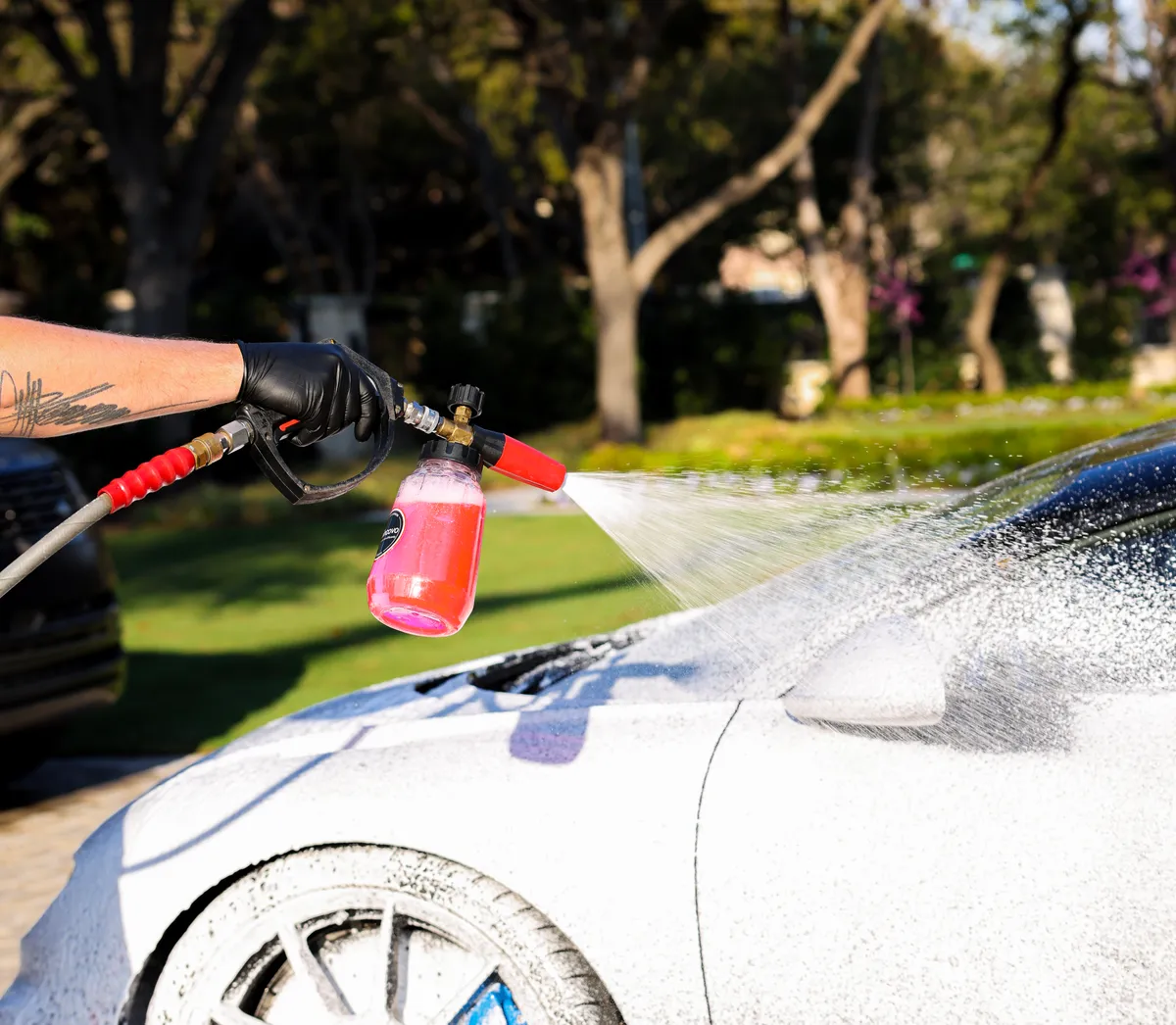
Automatic tunnels are hard on black paint. Even touchless washes use high-pressure water that carries particulates suspended in it. And hand washing, done without proper technique, proper lubrication, or clean mitts, creates the same spiral scratch patterns you see under a light. The scratches come from everywhere, all the time, in layers.
The other factor unique to Texas is UV intensity. Prolonged UV exposure does not cause swirl marks, but it does cause the clearcoat itself to haze and dull over time. On a black car, the difference between a well-maintained surface and a UV-degraded one is dramatic. That deep, wet-looking gloss fades to something flat and gray. No amount of wax or spray detailer reverses that. The only answer is paint correction.
What Paint Correction Does and Does Not Do
Paint correction is the process of removing a controlled amount of clearcoat using machine polishers and abrasive compounds, working through progressively finer stages until the surface is level. Scratches and swirl marks are not filled. They are removed by bringing the surrounding paint down to the depth of the defect, or as close to that as the remaining clearcoat allows.
The result, done correctly, is a surface that reflects light the way the factory intended, or better. On a black car that has been properly corrected under proper lighting, the difference is not subtle.
Here is what paint correction does not do. It does not add any protective layer. A corrected car in Dallas weather will begin accumulating new swirl marks from the very next wash if nothing changes in how it is washed or protected. Correction is the reset. Protection is what you do after.
This is also why the sequence matters. You do not apply a ceramic coating over defects and call it done. The coating locks whatever is underneath into place. A corrected surface gives the coating something worth preserving. A swirl-marked surface preserved by a ceramic coating is just preserved swirls.
Why Other Colors Are More Forgiving
The honest comparison looks like this:
| Color | Swirl Visibility | UV Fade Visibility | Forgiveness in Daily Driving |
|---|---|---|---|
| Black | Very high | Very high | Very low |
| Dark navy / dark blue | High | High | Low |
| Dark red / burgundy | Moderate | Moderate | Moderate |
| Silver / gray | Low | Low | High |
| White | Very low | Low | High |
Silver and white cars accumulate the same surface damage. They just show almost none of it under typical viewing conditions. This is not an argument for those colors. It is context for why black car owners tend to seek paint correction more often, and why they notice deterioration faster when nothing is done.
Dark blue and dark green fall between the extremes. They will show swirls under direct light but are slightly more forgiving than true black in everyday conditions.
The Right Approach for a Black Car in Dallas
If you own a black car here and you want it to actually look the way a black car is supposed to look, the honest approach is a two-step commitment.
Step one is correction. A single-stage polish handles moderate swirl marks and light oxidation. A multi-stage correction, which involves a more aggressive compound followed by a finishing polish, handles deeper scratches and heavier defects. The right approach depends on the condition of the paint and the remaining clearcoat thickness. Cutting into thin clearcoat to chase a deep scratch that cannot be fully removed is not worth it. An experienced technician measures before they cut.
Step two is protection, and the right protection depends on your priorities. A ceramic coating applied to a corrected black car will hold that gloss, add chemical resistance, and make maintenance washing significantly easier. Coatings are not permanent, and they do not self-heal scratches. They are durable, multi-year protection that preserves the corrected surface and makes the car easier to keep clean. Paint protection film goes further and actually does self-heal light scratches with heat exposure. For a black car driven regularly on DFW roads, PPF on high-impact areas like the hood, front bumper, and mirrors is a reasonable investment on top of or instead of a full coating, depending on the owner’s priorities and budget.
Neither of these is a substitute for correct washing technique. Two-bucket hand washing, clean microfiber, proper drying. That discipline extends the life of correction and coating both.
One Practical Takeaway
Black cars earn their reputation for being high-maintenance. But most of what owners dislike about them, the haze, the swirls, the flat look, is correctable. The problem is not the color. It is that black paint tolerates no shortcuts, and most cars driven in Dallas have been through years of shortcuts before anyone looks closely under a light.
Get the paint assessed under proper lighting before deciding on any service. The condition of the clearcoat determines what is possible. Good correction work followed by the right protection plan will hold for years, but only if the foundation is honest to begin with. Start there.