
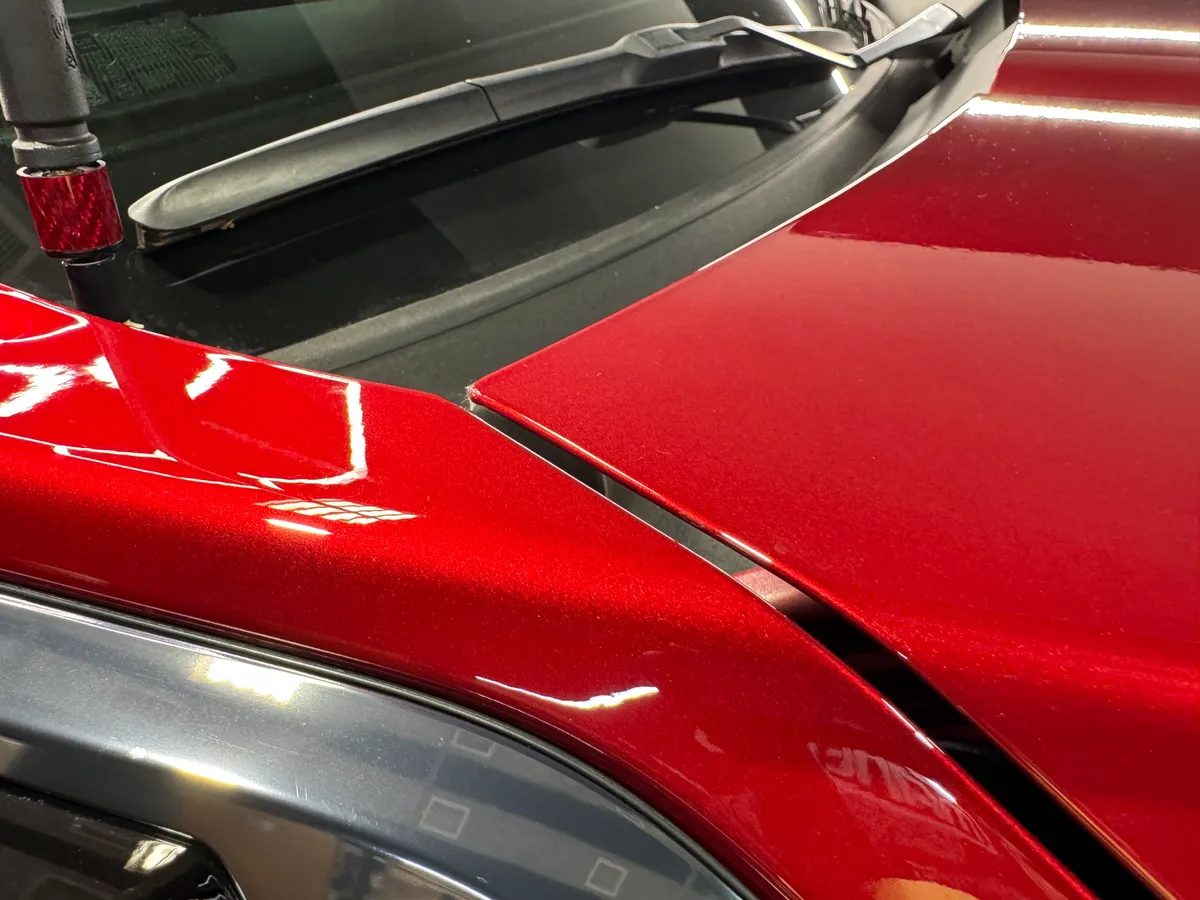
Two cars come into the studio for paint correction on the same morning. One leaves after a single afternoon of polishing. The other is here for a day and a half. Both owners paid for “paint correction.” Neither was overcharged or shortchanged. They simply needed different amounts of work, and the gap between a one-step enhancement and a full multi-stage correction is one of the most misunderstood things in this trade.
If you are about to spend money correcting your paint, especially before a ceramic coating, you should understand what you are actually buying. Here is how correction works, what the stages mean, and why the clear coat itself sets the limit on how far anyone can go.
What Paint Correction Actually Is
Paint correction is machine polishing. It is not a product you apply, not a coating, and not a wash. It is the process of using a machine, a pad, and an abrasive compound or polish to remove a very thin layer of clear coat in order to level the surface.
Your paint defects, the swirls, the scratches, the etching, are tiny valleys cut into the clear coat. Polishing does not fill those valleys. It carefully levels the surrounding surface down to the bottom of them, so the defect and the surface around it become one even plane. When that happens, light reflects evenly again and the defect disappears.
That is the key idea. Correction removes material to remove defects. It is permanent, and it cannot be undone, which is exactly why it has to be done with measurement and restraint.
The Defects Correction Removes
Different defects sit at different depths, and that depth is what determines how aggressive the correction has to be.
Swirl marks are fine, shallow scratches, usually in a circular web pattern, caused by improper washing and drying. Automatic car washes with brushes are the most common cause in Dallas. Swirls are typically shallow and respond to light correction.
Light oxidation is the dull, slightly hazy look paint takes on after UV exposure. Texas sun accelerates it. Light oxidation polishes out. Heavy, chalky oxidation needs more aggressive cutting.
Water spots that remain after washing are mineral etching in the clear coat. Hard water is common across DFW, and once a spot has etched in, only machine polishing levels it back out.
Scratches vary. A scratch your fingernail glides over is in the clear coat and is usually correctable. A scratch your nail catches in has gone through the clear coat into the base, and no amount of polishing fixes that. That one needs paint, not correction.
The mix and depth of these defects is what decides whether your car needs one stage or several.
One-Step Correction (Paint Enhancement)
A one-step correction, sometimes called a paint enhancement or a polish, uses a single combination of pad and product to do as much as one pass can reasonably do.
It is the right choice for paint that is in generally good shape: light swirls, mild haze, a car that has been reasonably cared for. A one-step will not make the paint flawless under a studio inspection light, but it removes a large share of visible defects and brings back real gloss and depth. The improvement is dramatic for the time invested.
A thorough one-step on a mid-size vehicle is typically a half-day of work. It is the practical, sensible level of correction for a daily driver whose owner wants the paint looking sharp without paying for perfection that daily driving will erode anyway.
What it will not do is remove deeper scratches, heavy oxidation, or established etching. Those need more.
Multi-Stage Correction
A multi-stage correction uses two or more distinct steps. A more aggressive cutting stage first, to remove the deeper defects, followed by one or more refining stages with finer products and softer pads to polish out the haze the cutting step leaves behind and bring the finish to its highest clarity.
This is the level for paint with real problems: heavy swirling, deeper scratches, oxidation, prior bad polishing with holograms or buffer trails, or paint that simply has not been touched in years. It is also the level for the customer who wants the finish as close to flawless as the clear coat allows, often on a higher-end vehicle.
Multi-stage correction is a serious time investment, frequently a full day or more, because every panel gets worked multiple times and the work is checked under multiple light sources between stages. The result is the difference, though. Done properly, multi-stage correction produces a finish with a depth and clarity a one-step cannot reach.
Not sure which level your paint needs? That is exactly what an in-person inspection answers. At Protektd Detailing’s Dallas studio, we measure your clear coat, assess the defects under proper lighting, and tell you honestly whether a one-step or multi-stage correction is the right call, before you commit to anything. Request a quote or read more about our paint correction service.
Why Correction Comes Before a Coating
This is the part too many people get wrong, and it costs them.
A ceramic coating bonds to your clear coat and stays there for years. It is a hard, long-lasting layer. Whatever the paint looks like the day the coating cures is what it will look like for the full life of that coating. The coating does not hide defects. It seals them in.
Worse, a coating adds gloss, and gloss increases contrast, and higher contrast makes existing swirls and scratches more visible, not less. Coat over uncorrected paint and you have paid to make the flaws more obvious and locked them in at the same time.
The correct order is never negotiable on a real-world car: correct first, then coat. The correction creates the flawless foundation. The coating preserves it. Skip the correction and you are protecting defects. The same logic applies before paint protection film. Film goes on clear and lifts nothing, so anything underneath stays visible through it.
If a shop offers to coat your car without discussing correction first, that is a real warning sign.
The Limit: Clear Coat Is Finite
Here is the constraint that governs everything above. Your factory clear coat is not thick. Most vehicles have roughly 1.5 to 2.5 mils of clear coat, and that thin layer is what protects the colored paint beneath it and gives the finish its gloss.
Every correction pass removes a small fraction of a mil. A one-step removes very little. A multi-stage correction removes more. It is still a fraction of the total, but it is not nothing, and the clear coat does not grow back.
This is why correction cannot be done infinitely. A car can be safely corrected a limited number of times over its life before the clear coat gets too thin to polish without risking failure. Polish through the clear coat and you expose the base paint, and at that point the only fix is a respray.
A responsible installer measures clear coat thickness with a paint gauge before correcting. That reading tells us how much working room you have and how aggressive we can responsibly be. On a car that has been polished hard before, there may be less margin than the owner expects, and the honest answer is sometimes a gentler correction that leaves a defect or two rather than risking the clear coat.
This is also the strongest argument for protecting the paint after correction. Correct once, coat or film it, and the protection takes the wear instead of the clear coat. That preserves your correction budget for the life of the car.
How to Choose
You do not have to diagnose your own paint. That is the installer’s job, and it requires hands and eyes on the car under proper light, plus a paint gauge. But you can walk in informed:
- If your car is in decent shape and you want it looking noticeably better without chasing perfection, a one-step is likely the sensible, cost-effective choice.
- If your paint has deeper scratches, oxidation, prior bad polishing, or you want the finish as close to flawless as possible, especially before a coating, you are looking at multi-stage.
- If a coating or PPF is the goal, budget for the correction as part of it, not as an optional extra.
The Bottom Line
Paint correction is not one fixed service. It is a spectrum, from a single refining pass to a full multi-stage rebuild of the finish, and the right point on that spectrum depends entirely on your paint’s actual condition and how much clear coat it has to give.
Get the diagnosis right, respect the limit the clear coat sets, and correct before you coat. Do that, and the protection you pay for is preserving a finish worth preserving.