
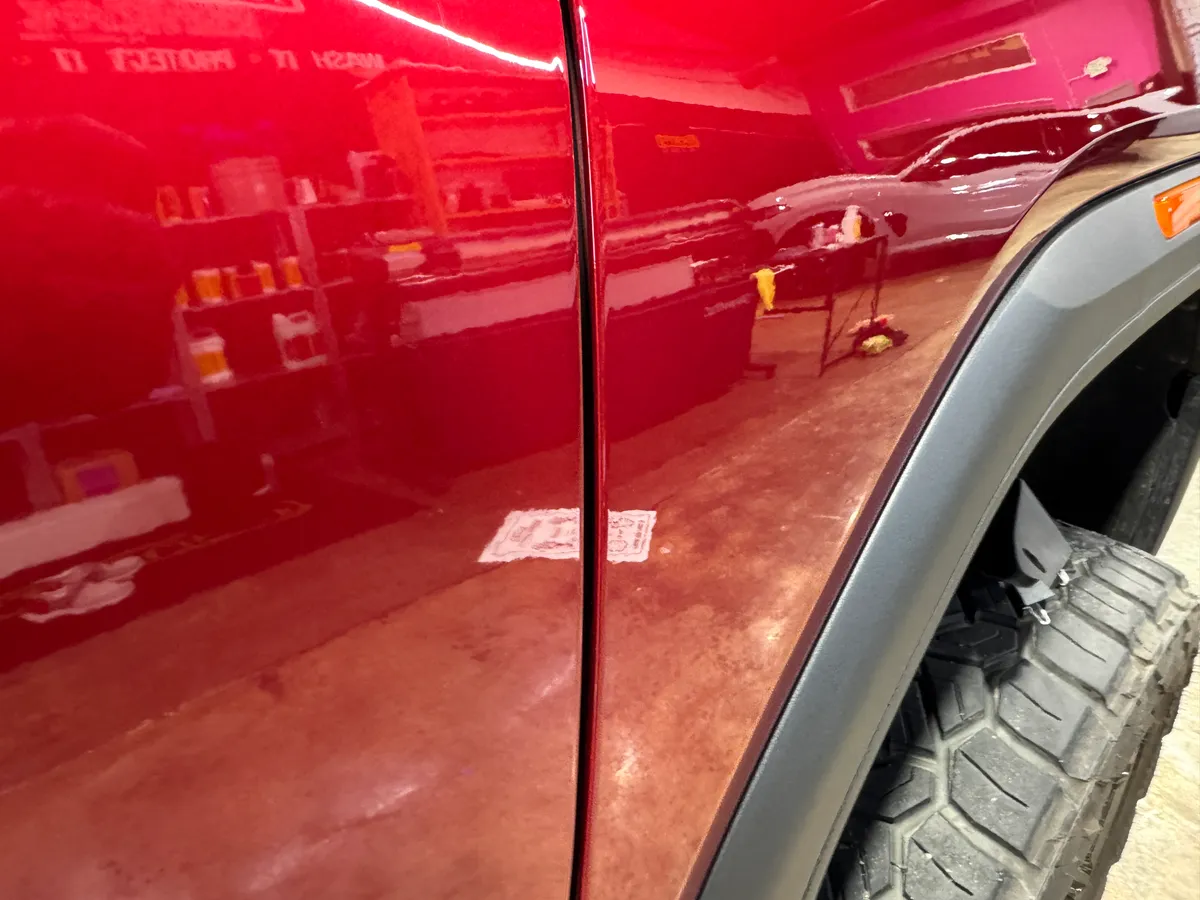
One of the most common mistakes in vehicle protection is applying ceramic coating over paint that needed correction first. The coating doesn’t hide defects. In many cases, it makes them more visible by adding gloss that draws the eye to every imperfection.
Paint correction before coating isn’t optional on most real-world vehicles. Here’s how to tell if your car needs it.
Why This Order Matters
Ceramic coating forms a long-lasting bond with your clear coat. Whatever is on the surface when the coating cures stays there, sealed under a hardened layer you can’t polish through without removing the coating itself.
If your paint has swirl marks, water spots, or oxidation, those defects are going to be there for the full life of the coating, which, in a properly installed professional package, can run for years.
The coating amplifies gloss. Gloss amplifies contrast. High contrast makes defects more visible. This is why paint correction is foundational to ceramic coating installation, not an optional add-on.
The 7 Signs
1. Swirl Marks in Bright Light
Look at your paint in direct sunlight or under a fluorescent garage light at a 45-degree angle. If you see a circular pattern of fine scratches, like a web of light scratches spreading across the panel, those are swirl marks.
Swirls come from improper washing and drying. Automatic car washes with brush contact are the most common culprit in Dallas. Even incorrect hand washing (wrong towels, improper technique, rubbing with too much pressure) creates swirls over time.
Under ceramic coating gloss, swirl marks become significantly more visible.
2. Water Spots That Don’t Wash Off
Water spots that disappear when you wash the vehicle are mineral deposits sitting on the surface. They’re easy to remove and don’t require correction. Water spots that remain after washing are a different problem.
Hard water spots (common in Dallas, where tap water has high mineral content) can etch into the clear coat over time. Once etched, they can’t be removed with washing or detailing spray. They require machine polishing to level the surface.
Coating over etched water spots seals them in.
3. Bird Dropping Damage
Bird droppings are acidic. In Dallas heat, they etch clear coat faster than in cooler climates. If dropping damage has been sitting on your paint for more than a few hours in summer, there’s a good chance it’s left shallow etching.
These show up as slightly dull or matte-looking areas, often in the shape of the dropping. They’re not always obvious until you look closely under direct light.
4. Buffer Trails
If your vehicle has been polished before by someone who didn’t know what they were doing (or who used equipment incorrectly), you may have buffer trails, swirl marks with a different character than wash swirls. They often show as hazy arcs or concentrated swirl patterns and are usually more visible than standard wash swirls.
These need to be polished out before any coating.
5. Visible Scratches You Can Feel
Run your fingernail very lightly across a scratch. If your nail catches in it, the scratch is through the clear coat, and it’s not removable by polishing. Those require touch-up paint or respray, not correction.
Scratches your nail slides over but that are visible under direct light are typically in the clear coat only and are candidates for correction.
6. Dull, Hazy, or Flat Paint
Paint that has lost its depth and gloss, especially on horizontal surfaces (hood, roof, trunk) that face direct sun, has likely oxidized. Dallas’s UV intensity accelerates this on unprotected paint.
Light oxidation can be corrected. Heavy oxidation (chalky, rough texture) may require more aggressive cutting and could limit how close to perfect the finish gets.
7. Uneven Gloss Across Panels
If different panels have noticeably different gloss levels, some have been polished or touched up and others haven’t. This uneven baseline will become more obvious under ceramic coating.
A correction process evens out the surface across all panels, creating a consistent foundation for the coating.
What Paint Correction Actually Involves
Machine polishing removes a very thin layer of clear coat to level the surface. This requires:
- The right compound for the defect level: Heavy cutting compounds for significant oxidation and deep swirls, light polishes for fine swirls and light imperfections. Using the wrong combination either removes too little material (defects remain) or too much (clear coat is dangerously thin).
- The right pad: Cutting pads are more aggressive than polishing or finishing pads. The pad-compound combination determines the cut rate.
- Proper machine speed and pressure: Too much heat or pressure creates new defects (holograms, buffer trails) instead of removing them.
A proper multi-stage correction typically involves:
- Wash and decontamination (clay bar to remove bonded surface contamination)
- Paint thickness measurement (to confirm there’s enough clear coat to polish safely)
- Test panel in a hidden area to dial in the compound-pad combination
- Panel-by-panel correction with overlapping passes
- Final IPA wipe to remove any polish residue
- Inspection under multiple light sources
This is not a fast process. A thorough single-stage correction on a mid-size vehicle takes 4–8 hours. A two-stage correction (heavy cut followed by finishing polish) can take a full day or more.
How Much Is There to Correct?
Paint thickness gauges tell us how much clear coat you have and how much room there is to work. Most factory paint has roughly 1.5–2.5 mils of clear coat. Aggressive correction removes a fraction of a mil, but if clear coat is already thin from prior polishing, there may be less margin available.
This is another reason why the in-person inspection matters before any quote. We need to see and measure the paint before we can tell you what’s achievable and what it will cost.
The Bottom Line Before Coating
If you’re investing in a ceramic coating, you’re investing in a long-term result. That result is built on what the paint looks like the day the coating goes on.
The question isn’t whether your paint has defects. Most vehicles on the road do. The question is whether you want those defects locked in under a coating for the next several years, or whether you want to address them first and coat clean.
For every vehicle we install ceramic coating on, we walk the owner through what we find in the assessment and what the correction options are. The decision on how far to take the correction is theirs, but we make sure they’re making it with accurate information.